
Back and spine questions, answered
Bulging or herniated disc: what your MRI does and doesn't mean
 By Dr. Jill Althoff, DC, founder of Althoff Wellness Clinic in Cheyenne, Wyoming. In practice since 2003 and author of two books on neuropathy.
Short answer
A disc bulge or herniation on an MRI doesn't automatically mean you need surgery, or even that the disc is causing your pain. Research on people with no back pain finds disc bulges in about half of 40-year-olds, and the number rises with age. What matters is how the findings match your symptoms and exam. Many people with disc problems explore non-surgical care, such as spinal decompression, before considering surgery.
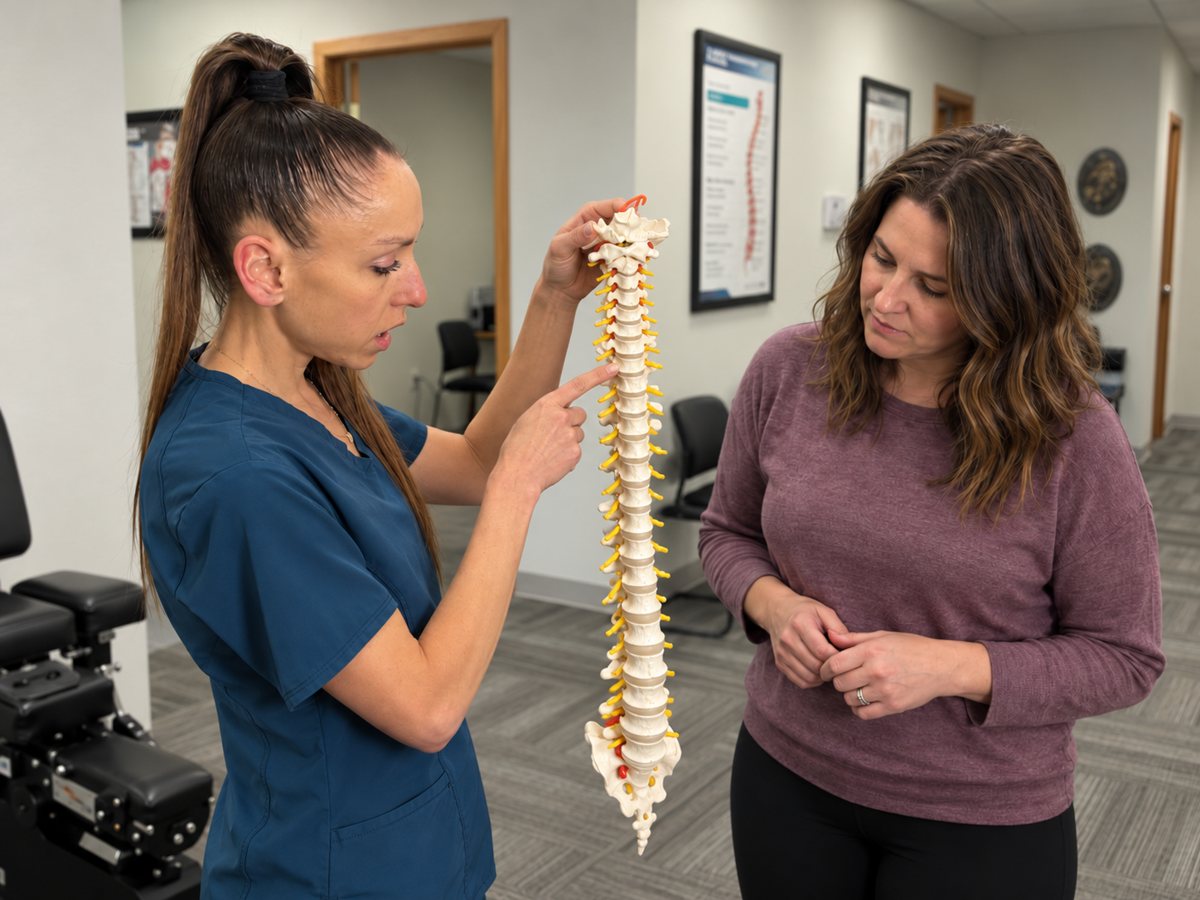
"My MRI showed a disc bulge. Do I need surgery?"
This is one of the most common fears I hear. Imaging is helpful, but it isn't the whole story. A large review of MRI studies in people with no back pain found disc bulges in about 30 percent of 20-year-olds, about half of 40-year-olds, and more than 80 percent of people in their 80s. Plenty of people have a bulge on their MRI and no pain at all. So we look at the whole picture: your symptoms, your exam, how you move, and your imaging together.
I've been there
I've had a disc herniation in my neck since a car accident years ago, and it has flared up a few times. I know what disc pain and nerve pain feel like, and I understand why people want relief fast.
Why I work hard to help people avoid spine surgery
Sometimes surgery is necessary, and when it is, we'll tell you. But I see surgery as a last resort, not a first step. Surgery changes how that part of the spine moves. After a fusion, the joints above and below have to work harder to do the same job, and those overworked segments can wear out faster over time. Some patients I see have had one spine surgery, then another a few years later.
Movement keeps joints healthy. I like to say motion is lotion. Our goal is to restore healthy movement so the spine can do its job.
How spinal decompression works

Spinal decompression is a gentle, motorized stretch of the spine while you lie comfortably on a table. Many of our patients find it so relaxing they fall asleep. We use it for the low back and the neck.
Here's how I explain it. Think of a disc like a sponge. A healthy sponge is soft, moist, and flexible. A sponge left out to dry gets thin and stiff. An injured disc that hasn't been moving well can behave a lot like that dry sponge: thinner, stiffer, and leaving less room for the nerves. Decompression is designed to gently take pressure off the disc and the joints, with the goal of better movement and less pressure on the nerves.
Who it may help, and who it isn't right for
We consider decompression for sciatica, disc bulges and herniations, low back and neck pain, and degenerative or arthritic changes in the spine. It isn't right for everyone. Your evaluation tells us whether it's a fit, and we'll refer you elsewhere if something needs medical or surgical attention. Results vary from person to person.
If you have numbness in the saddle area, new loss of bladder or bowel control, or rapidly worsening weakness, go to the emergency room. Read more about sciatica and warning signs.
More from Dr. A
This page is educational and is not a substitute for medical advice. Individual results vary.